
For most people, the choice between building a home and building a workshop feels like an either/or proposition. You pick a lot, build one or the other, and live with the compromise.
But in Spokane, a growing number of homeowners are rejecting that choice entirely. They’re building barndominiums, which combine stick-frame living quarters with a pole-building shop. It’s not a new idea nationwide, but it’s gaining serious traction here for one simple reason: it works.
This hybrid approach solves the real trade-off that homeowners face. You want a comfortable, durable living space. You also want affordable, open workshop space. A hybrid barndeminium delivers both without forcing you to choose.
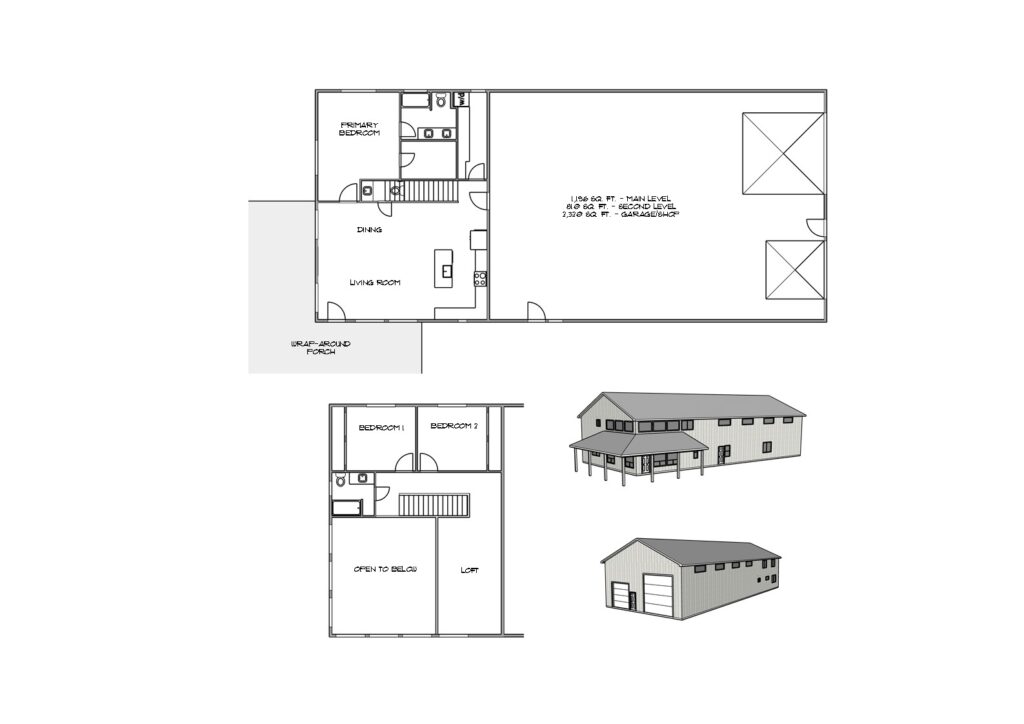

*Real example: A hybrid barndeminium designed by Spokane Home Design featuring stick-frame living quarters and pole-frame shop. This design like all our plans can be customized for barndominiums of any type and size.*
Here’s what you need to know about building one in Spokane, from the construction methods to the real costs to how you actually finance it.
—
## What is a barndeminium? And why Spokane is the perfect market
Let’s start with the basics. A **barndeminium** (also called a “shouse” in some circles) is a residential structure that combines living quarters with a barn, shop, or workshop space under one roof or as a cohesive building complex.
The term itself is a blend of “barn” and “condominium,” but it’s a bit of a misnomer. You’re not renting or co-owning anything. You own the whole property. The structure just happens to combine two very different functions.
In Spokane specifically, barndominiums make particular sense. You’ve got plenty of acreage available outside city limits, a lifestyle that values outdoor space and workshops, and a climate that demands thoughtful engineering. Plus, the local building community has the expertise to execute hybrid designs properly.
What makes the hybrid barndeminium different from an all-stick-frame home or an all-pole-barn structure is its practicality. An all-stick-frame home gives you durability and comfort, but the cost can be prohibitive if you also want workshop space. An all-pole-barn structure saves money, but living in one means accepting utilitarian finishes and less climate control than most people want. The hybrid approach lets you have both.
Link to: [custom-home-plans-spokane-home-design](https://spokanehomedesign.com/custom-home-plans-spokane-home-design/)
—
## Stick frame vs. pole building construction: What’s the difference
To understand why hybrid construction works, you need to understand how these two methods differ.
### Stick-frame construction (traditional)
Stick-frame building is what you see in most residential neighborhoods. The home sits on a concrete foundation or basement. Walls are built from 2×4 studs arranged in a frame, then covered with sheathing, insulation, and finishes.
The process requires:
– Extensive excavation and site preparation
– A full concrete foundation or basement (this is the expensive part)
– Framing, electrical, plumbing, HVAC all built into the stud walls
– Careful insulation between studs to handle temperature swings
– Drywall, paint, trim, and finished interior
**Cost reality:** That concrete foundation and site prep accounts for roughly 10-15% of your total building cost. That money is spent before you even start framing.
Stick-frame construction is slower upfront because of foundation curing time, but it produces the comfort level and durability that people expect from a home. Your heating and cooling work efficiently, moisture control is built in, and the structure feels solid.
### Pole-frame (post-frame) construction
Pole-frame construction (sometimes called “post-frame” or “post-and-beam”) works differently. Instead of a continuous concrete foundation, large posts (often 8×8 or larger) are driven 4+ feet into the ground. Roof trusses and wall panels attach to these posts.
The process is simpler:
– Site preparation (grading, maybe some light excavation)
– Posts driven into ground (no foundation needed)
– Roof trusses installed quickly
– Wall panels and doors attached
– The building is weathertight in weeks, not months
**Why this method exists:** It was developed for agricultural buildings where you need open, column-free interior space. A 100×60 barn needs to accommodate equipment and livestock without interior walls breaking up the space.
The trade-off is that pole-frame buildings historically look utilitarian. You see metal siding, simple interiors, and industrial aesthetics. But that’s changed. Modern pole-frame construction can look refined, especially when integrated with stick-frame living space.
### Why these methods work together (not separately)
Here’s where the hybrid approach makes sense: each method solves a different problem.
**Stick-frame is ideal for bedrooms, bathrooms, and living areas.** You want good insulation, tight climate control, finished interior, and the durability that people associate with “home.” These rooms justify the foundation cost.
**Pole-frame is ideal for shops, garages, and storage.** You don’t need (or want) the same level of finish. You want clear-span open space for tools, equipment, or workspace. The cost savings are real, and the faster construction timeline matters.
**The hybrid approach combines them strategically.** Your living portion gets the foundation and stick-frame treatment. Your shop portion gets the post-frame construction and cost savings. You avoid paying for residential-grade finish in a space that doesn’t need it, and you avoid building a shop-like shell for your living area.
Link to: [a-shop-house-shouse](https://spokanehomedesign.com/a-shop-house-shouse/)
—
## The hybrid barndeminium approach: Why Spokane homeowners are choosing it
The math on hybrid construction is compelling, but the real appeal is broader. Let’s look at what makes this approach work in practice.
### Cost efficiency without compromise
A real example: you’re building a 1,500 sq ft barndeminium with 1,000 sq ft of living space and 500 sq ft of shop.
For stick-frame only, you’d be looking at:
– Foundation + site prep: $15K-$22K
– Living-area framing: $150/sq ft
– Interior finishes, mechanical: $100K-$150K
– Total: roughly $320K-$400K
For the hybrid approach:
– Foundation + site prep (living area only): $10K-$15K
– Living-area framing (stick-frame): $150/sq ft = $150K
– Shop framing (pole-frame): $20/sq ft = $10K
– Interior finishes (mostly living area): $60K-$80K
– Total: roughly $240K-$330K
That’s a 20-25% savings compared to all stick-frame, while maintaining a fully livable, durable residential space.
### Design flexibility
One question homeowners always ask: won’t it look like a house bolted to a barn?
The answer is no, if it’s designed intentionally. Here’s what matters:
**Layout options exist.** You can build side-by-side (living on one side, shop on the other), front-back (living facing the street, shop behind), or even vertical (living upstairs in a loft style, shop below). Each approach has different trade-offs for entry, sight lines, and utilities.
**Visual continuity comes from details.** Matching exterior materials, consistent rooflines, and thoughtful color choices make the two portions feel integrated. The shop doesn’t have to look agricultural just because it’s pole-frame.
**Interior transitions matter.** Ceiling heights can differ (the shop can be taller), flooring can be utilitarian in the shop and finished in the living area, but the transition should feel intentional, not accidental.
### Climate engineering for Spokane
Spokane winters are serious. You can hit minus 20 Fahrenheit, and seasonal swings from summer heat to winter cold mean your structure has to handle stress from temperature changes.
Post-frame construction engineered for Spokane climate is as durable as stick-frame. The posts are driven deep, and roof trusses are engineered for the specific snow load your location experiences. The difference is that pole-frame construction gets this engineering upfront, so there’s no compromise.
Insulation is another consideration. With wide spacing between posts, you have room for thick insulation blankets or spray foam. The shop portion may not need the same insulation as living quarters, but if you want to use it year-round, adding insulation makes sense.
### Fast construction timelines
Timeline pressure is real for homeowners. Every month you’re not in the house is money lost (if you’re temporarily displaced) or money spent on rent or a construction loan with interest accruing.
A pole-frame shop shell can be weathertight in 2-4 weeks. The living area, being stick-frame, takes longer, but the overall project timeline for a hybrid is often 6-12 months end-to-end. That beats a traditional all-stick-frame build that can stretch 8-14 months.
## Designing a cohesive hybrid barndeminium
The challenge of hybrid construction isn’t the building methods themselves. It’s making them feel like one intentional design, not two buildings crammed together.
### Layout strategies
**Side-by-side design** puts living quarters on one side and the shop on the other. Pros: clear separation, easy utilities, straightforward traffic flow. Cons: requires good lot dimensions, can look visually split if not designed carefully.
**Front-back design** puts the living area facing the street (traditional house aesthetic) and shops behind. Pros: residential street presence, living area gets the best view. Cons: requires deeper lots, utility runs are longer.
**Vertical split** (loft-style) puts living upstairs and the shop downstairs. Pros: compact, efficient, modern aesthetic. Cons: requires good ceiling height for shop function, stairs take up space.
Each layout has merit. The choice depends on your lot, your lifestyle, and what you want the building to communicate to neighbors.
### Interior transitions
The living area will have finished drywall, trim, paint, and carpet or hardwood flooring. The shop will have concrete floors, raw framing visible (or exposed metal), and utility-focused finishes.
Where these two zones meet matters. If they’re visually jarring, the whole project feels awkward. Here’s what helps:
– **Consistent exterior materials** across both portions (same siding, same roof, same color palette)
– **Threshold details** that acknowledge the transition without making it feel accidental (a simple door jamb or framed opening works)
– **Complementary interior finishes** (the living area can be refined, the shop utilitarian, but both should be intentional)
### Utility integration
Most hybrid barndominiums use a single HVAC system with separate zones for the living and shop areas. That means the living area stays warm in winter, but you can dial back (or shut off) the shop if you’re not using it.
Electrical is typically split. The living area gets standard residential circuits. The shop gets heavier-gauge circuits for tool use, separate from the home’s main load.
Plumbing in the shop is usually minimal: maybe a utility sink and outdoor water spigot. The living area gets the full kitchen and bathrooms.
Site grading and drainage matter for both portions. You’re managing water runoff for the whole footprint, not separate systems.
Link to: [custom-home-floor-plan](https://spokanehomedesign.com/custom-home-floor-plan/)
—
## Making hybrid affordable: Financing, permits, and insurance
This is where practical reality sets in. Building a barndeminium in Spokane is one thing. Financing it, getting it permitted, and insuring it requires navigating some non-standard territory.
### Financing challenges (and solutions)
Traditional lenders get nervous about barndominiums. They’re not standard single-family homes, and the mixed-use nature (residential + shop) can raise questions.
**Reality check:** You may need to look harder for a lender, but options exist.
Construction loans are common. You borrow money to build, then convert to a permanent mortgage once the home is complete. Some lenders offer “land and home” packages if you’re also buying raw land.
If you have existing home equity, a personal loan or home equity line might work. Some builders finance in-house, though that’s less common.
The key is finding a lender experienced with barndominium construction. A local bank or credit union in Spokane might have seen these projects before. Big national lenders are often less flexible.
### Insurance considerations
Insurance companies classify barndominiums as “dwelling + agricultural building” or similar. The residential portion insures like a normal home. The shop portion might require a rider or separate commercial policy.
Get clarity on this before you break ground. You’ll need to document the square footage split (living vs. shop) and the intended use of each. An appraisal helps here. A property with 1,000 sq ft of residence and 500 sq ft of shop is insured differently than a 1,500 sq ft residence with no shop.
Permitting and codes
You will need structural engineering when building a barndeminium in Spokane because all structures With walls over 10 feet tall must have structural engineering to get permitted. But that is not a show stopper.
The important part: your design must meet local zoning and regional engineering codes. Spokane has specific snow load requirements (pounds per square foot), wind resistance specs, and foundation/framing standards. Professional plans engineer these requirements in.
This is where custom plans make a difference. Plans designed by someone who understands Spokane’s climate, soil, and codes pass inspection faster. Generic plans or DIY designs often run into issues mid-build, which gets expensive.
Permitting timeline is typically 8-16 weeks total (design, engineering, permit application, county review).
**Common FAQ questions:**
**How much does a hybrid barndeminium cost in Spokane?**
$240K-$330K for a 1,500 sq ft hybrid (1,000 living + 500 shop) is typical. The exact cost depends on finishes, customization, site conditions, and current material prices.
**Is a pole barn as durable as stick-frame?**
Yes, when properly engineered. Posts driven deep into ground plus engineered trusses handle Spokane winters just fine. The durability question isn’t about the method it’s about engineering and execution.
**How long does a barndeminium take to build?**
4-6 months for design and permitting, then 6-8 months for construction. Total: 6-12 months from start to move-in.
**Can I use my barndeminium for both living and business?**
Yes. Many Spokane builds combine residential living with a home office, workshop, or studio. Zoning and insurance typically classify this as “dwelling + agricultural/workshop building.”
—
Building a hybrid barndeminium in Spokane: Finding the right team
You’re not alone in building a hybrid barndeminium. The Spokane region has a growing community of builders and craftspeople experienced with these hybrid projects.
**Design specialists** create the plans and 3D visualizations. This is where your concept comes to life before any construction starts. A good designer understands both stick-frame residential building and pole-frame construction, and can integrate them seamlessly.
**Pole-frame specialists** have deep expertise in post-frame construction. They understand how to engineer posts, trusses, and building systems for your specific needs and climate conditions.
**General contractors** coordinate full hybrid builds, managing both the stick-frame living area and pole-frame shop. The best ones have experience with mixed-use construction and understand the unique challenges of integrating two different building methods.
**Prefab frame providers** offer pre-engineered components if you want to manage construction in phases or have more control over the building timeline.
When vetting any builder or contractor, ask for local references from recent projects (ideally from the past 2-3 years). Check if they have experience with hybrid designs specifically. Confirm they understand Spokane’s snow load engineering and regional building codes. Licensing and bonding are non-negotiable.
The design-first advantage matters more than you might think. Starting with professional plans (not rough sketches) prevents mid-build surprises. Plans include engineering, climate specs, and code compliance upfront. When builders work from solid, engineered plans, they can bid more accurately, fewer changes happen during construction, and you save money.
Start building a barndeminium in Spokane with professional plans
The hybrid barndeminium approach solves a real problem. You want affordability (hence the pole-frame shop). You want durability and comfort (hence the stick-frame living space). Combining them strategically delivers both without forcing you to compromise.
But combining them requires planning. Custom plans designed for Spokane’s climate, soil, codes, and zoning ensure you avoid expensive mistakes during construction.
Spokane Home Design specializes in exactly this. With 30+ years of hands-on building experience, including framing hundreds of homes, our plans are written by someone who understands what builders actually execute and what codes require. We design for Spokane’s specific conditions, not generic assumptions.
**Ready to explore your barndeminium vision?** [Contact us for a consultation](https://spokanehomedesign.com/contact-us/) or [view our Spokane house plans](https://spokanehomedesign.com/custom-spokane-house-plans/) to see how hybrid design looks in practice.
—
## Frequently Asked Questions
**Q1: What should you look for in a barndeminium builder in Spokane?**
A1: Look for builders with experience on hybrid stick-frame and pole-building projects. Ask for local references from the past 2-3 years. Confirm they understand Spokane snow load engineering and have successful projects nearby. Check licensing and bonding. A builder who’s worked with professional custom plans (rather than rough sketches) will give you better results.
**Q2: Does a barndeminium cost significantly less than a traditional stick-frame home?**
A2: Yes, typically 20-25% less for equivalent square footage when using the hybrid approach. A 1,500 sq ft hybrid runs $240K-$330K, while an all-stick-frame home of the same size costs $320K-$400K. The savings come from avoiding expensive foundation and finish costs in the shop portion.
**Q3: Can you build a barndeminium in a residential neighborhood in Spokane?**
A3: It depends on local zoning. Rural zoning typically allows barndominiums on 1+ acre lots. Residential-only neighborhoods usually don’t. Check with Spokane County planning before committing to a lot.
**Q4: How does financing a hybrid barndeminium differ from financing a regular home?**
A4: Traditional lenders are sometimes hesitant because barndominiums are non-standard. You may need to work with local banks or credit unions experienced with these projects. Construction loans are common, and some lenders offer land-plus-home packages. Shop around options exist, but you’ll likely need to demonstrate the builder’s experience.
**Q5: Is a pole-frame shop portion as insulated as a stick-frame living area?**
A5: Not automatically. Pole-frame buildings can be insulated very well (you have room for thick blankets or spray foam between wide post spacing), but they often aren’t. If you want to use your shop year-round, budget for insulation. If it’s seasonal storage, you can skip it and save money.
**Q6: How long is the permitting process for a barndeminium in Spokane?**
A6: Typically 8-16 weeks total. Design and engineering takes 4-6 weeks. The permit application and county review takes another 2-6 weeks. Having professional plans stamped by an engineer accelerates this process significantly.
**Q7: What does a hybrid barndeminium look like when it’s finished?**
A7: It depends on design. Most look like a residence with an attached or nearby shop. With intentional design (matching materials, consistent roofline, complementary colors), the two portions feel cohesive. Without it, they look disconnected. Custom plans ensure the first outcome.
